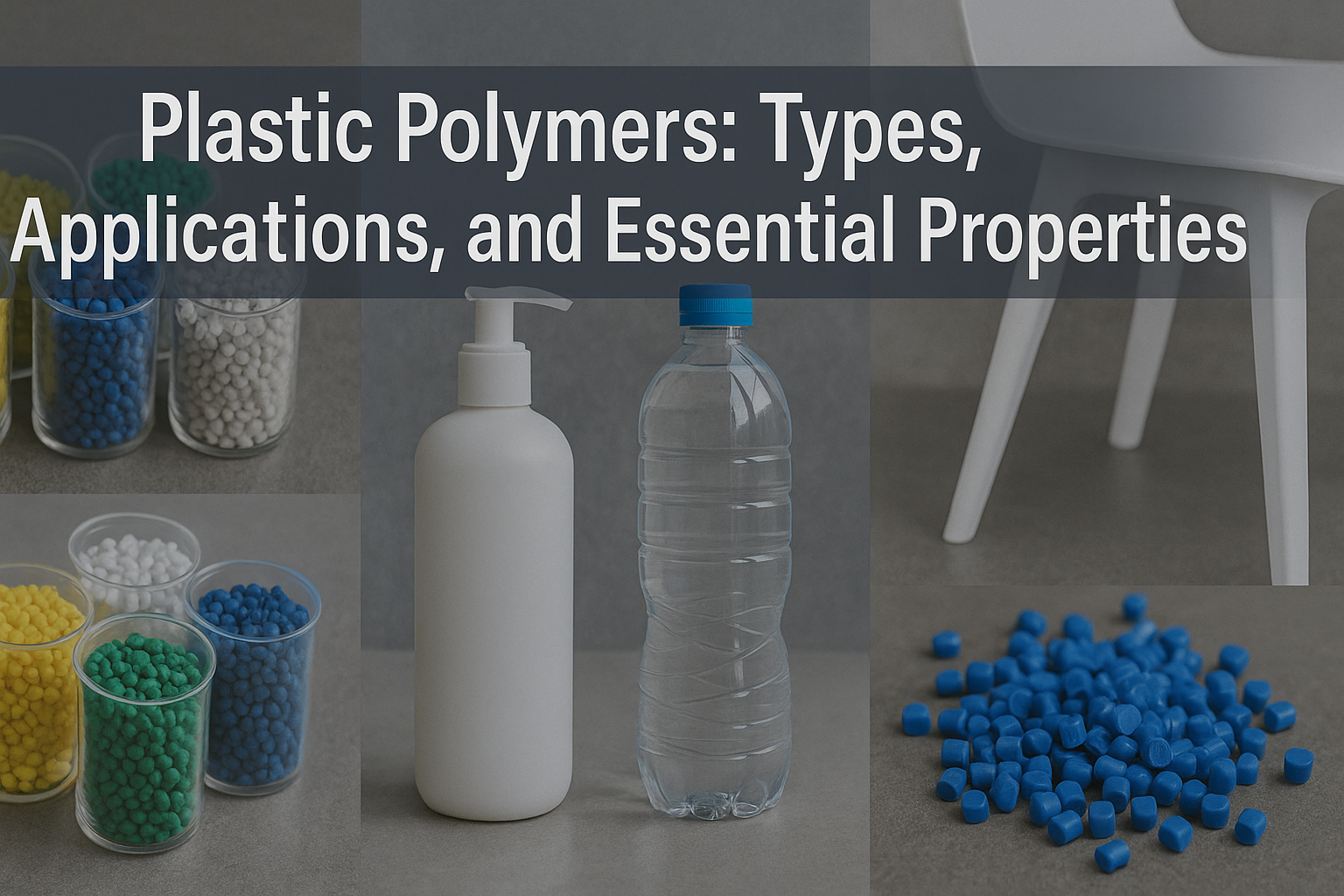
Plastic polymers have revolutionized countless industries with their versatility, durability, and customizable properties. This article explores major polymer types, their applications, and the critical properties required for each use case,including important trading specifications.
When purchasing polymers for industrial applications, several critical properties are typically specified in trade documents:
| Property | Description | Importance |
|---|---|---|
| Ash Content | Percentage of inorganic residue after complete combustion | Indicates purity level and presence of fillers, additives, or contaminants |
| Melt Flow Index (MFI) | Rate of extrusion through standardized die under specific conditions | Critical for processability and end-use performance |
| Molecular Weight/Distribution | Average length of polymer chains and their distribution | Impacts strength, processability, and crystallization |
| Volatile Matter Content | Percentage of material that evaporates under specified conditions | Affects processing stability and finished product quality |
| Moisture Content | Amount of water present in the resin | Can cause processing issues like hydrolysis or bubbles |
| Bulk Density | Weight per unit volume of granules/powder | Important for storage, transport, and feeding equipment |
| Particle Size Distribution | Range and distribution of resin particle sizes | Affects flow properties and processing consistency |
| Color/Appearance | Visual specifications including color, transparency | Critical for aesthetic applications and consistency |
| Contamination Level | Presence of foreign particles, gels, or discoloration | Impacts final product quality and processability |
| Property | Typical Value/Range | Importance for Applications |
|---|---|---|
| Density | 0.910-0.940 g/cm³ | Determines flexibility and permeability |
| Melt Flow Index (MFI) | 0.2-20 g/10 min | Critical for processing (extrusion, film blowing) |
| Tensile Strength | 8-12 MPa | Important for load-bearing applications |
| Elongation at Break | 100-650% | Provides stretchability for films |
| Thermal Properties | Melting point: 105-115°C | Determines heat resistance limitations |
| Chemical Resistance | High resistance to acids, bases | Critical for packaging applications |
| Impact Strength | Moderate to high | Important for drop resistance |
| Transparency | Translucent to opaque | Affects visual properties and UV protection |
| Ash Content | Typically <0.1% | Indicates purity and additive content |
HDPE features a more linear molecular structure with minimal branching, allowing polymer chains to pack more tightly. This results in higher density, increased crystallinity, and superior strength compared to LDPE.
| Property | Typical Value/Range | Importance for Applications |
|---|---|---|
| Density | 0.941-0.965 g/cm³ | Higher density provides rigidity and barrier properties |
| Melt Flow Index (MFI) | 0.1-18 g/10 min | Determines processability and suitable manufacturing methods |
| Tensile Strength | 20-40 MPa | Critical for structural applications |
| Impact Strength | High (10-80 kJ/m²) | Essential for containers and impact-resistant parts |
| Thermal Properties | Melting point: 120-140°C | Determines upper temperature limits |
| Chemical Resistance | Excellent to most solvents | Important for chemical containers |
| ESCR | Moderate to high | Critical for long-term durability |
| Water Absorption | Very low (<0.01%) | Important for moisture barrier applications |
| Ash Content | Typically <0.1% | Indicator of purity for critical applications |
LLDPE combines features of both LDPE and HDPE. It has a linear backbone like HDPE but with short, uniform branches. This structure provides improved tensile strength, puncture resistance, and impact resistance compared to LDPE while maintaining good flexibility.
| Property | Typical Value/Range | Importance for Applications | Density | 0.915-0.940 g/cm³ | Balances flexibility and strength |
|---|---|---|
| Melt Flow Index (MFI) | 0.1-5 g/10 min | Critical for film processing |
| Tensile Strength | 10-30 MPa | Higher than LDPE, important for durability |
| Puncture Resistance | High | Critical for packaging applications |
| Tear Resistance | Excellent | Important for films and bags |
| Impact Strength | Superior to LDPE | Essential for thin film applications |
| Thermal Properties | Melting point: 120-130°C | Determines heat-sealing parameters |
| Ash Content | Typically <0.1% | Important for film clarity and consistency |
Polypropylene is a versatile thermoplastic polymer with exceptional chemical resistance, good fatigue resistance, and excellent heat resistance. Its molecular structure features a methyl group (CH₃) attached to every other carbon in the backbone.
| Property | Typical Value/Range | Importance for Applications |
|---|---|---|
| Density | 0.895-0.920 g/cm³ | Lighter than most plastics, good strength-to-weight ratio |
| Melt Flow Index (MFI) | 1-40 g/10 min | Determines processability and end-use properties |
| Tensile Strength | 30-40 MPa | Important for structural applications |
| Flexural Modulus | 1.1-1.6 GPa | Critical for stiffness in applications |
| Heat Deflection Temperature | 90-120°C | Enables hot-fill applications |
| Thermal Properties | Melting point: 160-170°C | Determines high-temperature performance |
| Chemical Resistance | Excellent to most acids and bases | Critical for chemical containers |
| Ash Content | Typically <0.1% for virgin; can be 1-20% for filled grades | Indicates level of inorganic additives like talc or calcium carbonate |
| Isotactic Index | >90% for homopolymer | Determines crystallinity and properties |
PVC is one of the most widely produced synthetic polymers, valued for its durability, fire resistance, and cost-effectiveness. Its versatility stems from the ability to modify its properties through additives, particularly plasticizers.
| Property | Typical Value/Range | Importance for Applications |
|---|---|---|
| Density | 1.3-1.45 g/cm³ | Higher density affects weight considerations |
| Tensile Strength | 10-60 MPa (varies by formulation) | Important for structural applications |
| Shore Hardness | A40-D80 (varies widely with plasticizer content) | Determines rigidity/flexibility |
| Thermal Properties | Heat distortion temp: 65-85°C (rigid) | Limits high-temperature applications |
| Electrical Resistivity | 10¹⁵-10¹⁶ Ω·cm | Important for electrical insulation |
| Fire Performance | Self-extinguishing (with proper additives) | Important for construction applications |
| Ash Content | Typically 0.1-15% (depending on fillers) | Indicates mineral filler content, impacts processing |
| K-Value | 55-80 | Trading specification indicating molecular weight |
| Plasticizer Content | 0-50% (flexibility increases with content) | Determines rigidity/flexibility balance |
Rigid PVC (uPVC/PVC-U):
Flexible PVC (PVC-P):
PET is a semicrystalline thermoplastic polyester known for its excellent barrier properties, transparency, and strength. It can exist in both amorphous (transparent) and crystalline (opaque) states depending on processing conditions.
| Property | Typical Value/Range | Importance for Applications |
|---|---|---|
| Density | 1.33-1.45 g/cm³ | Affects weight and barrier properties |
| Intrinsic Viscosity (IV) | 0.45-1.2 dL/g | Critical trading specification determining molecular weight |
| Tensile Strength | 50-70 MPa | Important for structural integrity |
| Barrier Properties | Excellent to O₂, CO₂ | Critical for beverage containers |
| Thermal Properties | Melting point: 245-265°C, Tg: 70-80°C | Determines processability and heat resistance |
| Ash Content | Typically <0.1% | Critical for optical properties and processing |
| Acetaldehyde Content | 1-10 ppm | Trading specification for bottle-grade PET (flavor impact) |
| Color (L*, b*) | Varies by grade | Trading specification for appearance |
Bottle Grade PET (IV: 0.76-0.84 dL/g):
Film Grade PET (IV: 0.60-0.70 dL/g):
Fiber Grade PET (IV: 0.55-0.67 dL/g):
Polystyrene is a versatile polymer available in several forms with widely varying properties. The presence of benzene rings in its molecular structure contributes to its rigidity and brittleness in its general-purpose form (GPPS).
| Property | Typical Value/Range | Importance for Applications |
|---|---|---|
| Density | 1.04-1.09 g/cm³ (GPPS), 0.02-0.06 g/cm³ (EPS) | Affects weight and insulation properties |
| Melt Flow Index (MFI) | 2-20 g/10 min | Determines processability |
| Tensile Strength | 30-55 MPa (GPPS), 0.2-0.6 MPa (EPS) | Important for structural applications |
| Impact Strength | Low (GPPS), High (HIPS) | Critical for durability |
| Thermal Properties | Heat deflection temp: 70-100°C, Glass transition (Tg): ~100°C | Limits high-temperature applications |
| Ash Content | <0.1% for GPPS, can be higher for filled or flame-retardant grades | Indicator of additive content |
| Residual Monomer | 300-1000 ppm | Critical trading specification for food contact applications |
| Molecular Weight | 100,000-400,000 g/mol | Determines processability and mechanical properties |
General Purpose Polystyrene (GPPS):
High-Impact Polystyrene (HIPS):
Expandable Polystyrene (EPS):
ABS is a terpolymer consisting of acrylonitrile, butadiene, and styrene, combining the strength and rigidity of acrylonitrile and styrene with the toughness of butadiene rubber.
| Property | Typical Value/Range | Importance for Applications |
|---|---|---|
| Density | 1.03-1.07 g/cm³ | Affects part weight |
| Melt Flow Index (MFI) | 1-40 g/10 min | Critical for processing selection |
| Tensile Strength | 35-50 MPa | Important for structural applications |
| Impact Strength (notched Izod) | 100-400 J/m | Critical for durability in tough applications |
| Ash Content | Typically <0.5% for virgin; can be higher for filled grades | Indicates purity and additive content |
| Gels/Black Specks | Trading specification (count per unit area) | Critical for appearance-sensitive applications |
| Color (L*, a*, b*) | Trading specification | Important for consistency in appearance |
| Gloss | Trading specification | Especially important for visible parts |
General Purpose ABS:
 Polymer Prime